






 Web-based Loyalty Platform
 Loyalty App

 e-Voucher










 Blog
Blog 


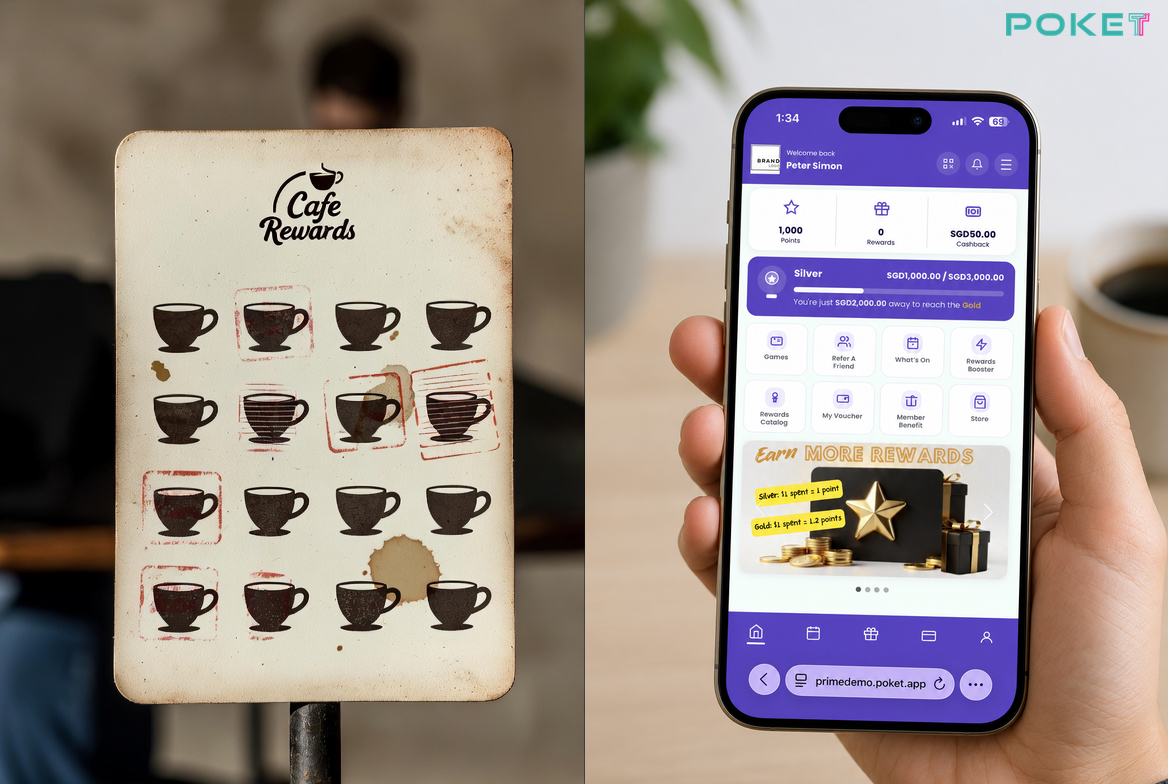
Paper stamp cards have been used by businesses for decades to encourage repeat purchases. But as customers increasingly expect convenient digital experiences, many businesses are asking: Is it better to use a traditional paper stamp card or a digital rewards system?
The answer depends on your business objectives.
If you simply want to reward customers after a certain number of purchases, a paper stamp card can still be effective. However, if you want to collect customer data, automate engagement, personalise rewards, manage multiple locations and build long-term customer relationships, a digital rewards system is generally the more scalable option.
In this guide, we compare digital rewards systems and paper stamp cards, including their advantages, disadvantages, costs, flexibility and suitability for different types of businesses.
Digital Rewards System vs Paper Stamp Cards: Quick Answer
A digital rewards system is generally better for businesses that want to grow customer retention and build long-term customer relationships. It provides greater flexibility, customer data, automation, reporting and personalisation than a traditional paper stamp card.
However, paper stamp cards may still be suitable for very small businesses that only need a simple buy-and-reward programme and do not require customer data or automated marketing.
The best choice depends on whether your goal is simply to reward repeat purchases or to build a complete customer loyalty programme.
What Is a Paper Stamp Card Loyalty Programme?
A paper stamp card is one of the simplest types of loyalty programmes.
The process usually works like this:
A customer receives a paper stamp card.
The customer makes a purchase.
The business adds a stamp to the card.
The customer collects a predetermined number of stamps.
The customer receives a reward.
For example:
Buy 9 coffees and receive the 10th coffee free.
This type of loyalty programme is popular among cafés, restaurants, salons, retail stores and other small businesses because it is simple to understand and inexpensive to launch.
Advantages of Paper Stamp Cards
Paper stamp cards offer several benefits:
Low initial cost
Simple to set up
Easy for customers to understand
No software or technical integration required
Suitable for simple reward programmes
Familiar to customers
For a small business with one location and a straightforward loyalty offer, a paper stamp card may be sufficient.
Disadvantages of Paper Stamp Cards
However, paper stamp cards also have significant limitations.
1. Customers Can Lose Their Paper Stamp Cards
Customers may forget to bring their paper stamp card or lose it completely. When this happens, the business may have no reliable way to restore the customer’s accumulated stamps.
2. Limited Customer Data
A paper stamp card usually tells the business very little about the customer.
It may show that a customer has collected several stamps, but it generally does not provide useful information such as:
Customer purchase history
Purchase frequency
Total spending
Product preferences
Customer lifetime value
Last purchase date
Without customer data, it is difficult to create targeted loyalty campaigns.
3. Limited Reward Flexibility
Paper stamp cards are generally designed for a simple reward structure.
For example:
Collect 10 stamps and receive a free product.
More complex loyalty mechanics, such as tiered memberships, points multipliers, referral rewards and personalised promotions, are difficult to manage using paper stamp cards.
4. Manual Administration
Staff must physically stamp or mark the card for every qualifying transaction.
For businesses with multiple locations or high transaction volumes, this can become difficult to manage consistently.
5. Limited Customer Engagement
A paper stamp card generally interacts with customers only when they visit the business.
It cannot easily send:
Welcome messages
Birthday rewards
Reward reminders
Re-engagement campaigns
Personalised offers
This means the business has limited ability to engage customers between purchases.
What Is a Digital Rewards System?
A digital rewards system is a technology-based loyalty programme that allows businesses to reward customers and manage customer engagement digitally.
Depending on the platform, customers may earn rewards through:
Purchases
Points
Digital stamps
Referrals
Special promotions
Social media engagement
Reviews
Membership activities
Customers can typically access their loyalty account through a mobile phone number, QR code, digital membership card, mobile app or web-based platform.
A digital rewards system can also provide businesses with tools to manage:
Customer profiles
Purchase history
Points
Rewards
Membership tiers
Digital vouchers
Store credits
Campaigns
Customer segmentation
Loyalty analytics
This means a digital rewards system can go far beyond simply replacing a paper stamp card.
Digital Stamp Card vs Digital Rewards System: What Is the Difference?
This is an important distinction.
A digital stamp card simply replaces the paper stamp card with a digital version.
For example:
Collect 10 digital stamps and receive a reward.
A digital rewards system can provide a much broader range of loyalty and customer engagement capabilities.
For example, customers may be able to:
Earn points for purchases
Unlock VIP membership tiers
Receive birthday rewards
Refer friends
Redeem digital vouchers
Earn store credits
Receive personalised offers
Participate in gamification campaigns
In simple terms:
A digital stamp card digitises a traditional loyalty mechanic. A digital rewards system can become a complete customer loyalty and engagement platform.
Digital Rewards System vs Paper Stamp Cards: Comparison
| Feature | Paper Stamp Card | Digital Rewards System |
|---|---|---|
| Customer convenience | Requires a physical card | Accessible digitally |
| Risk of losing rewards | High | Lower with account-based records |
| Customer data | Very limited | Detailed customer profiles and activity |
| Reward flexibility | Basic | Highly configurable |
| Customer communication | Manual | Automated |
| Personalisation | Limited | Customer segmentation and targeted rewards |
| Fraud prevention | More difficult | Digital tracking and controls |
| Reporting | Manual | Digital analytics and reporting |
| Multi-store management | Difficult | Centralised management |
| Scalability | Limited | Highly scalable |
| Customer engagement | Mainly during purchases | Can continue between purchases |
1. Customer Convenience
One of the biggest advantages of a digital rewards system is convenience.
With a paper stamp card, customers must remember to bring the card with them.
If they forget it, they may not receive their stamp.
With a digital loyalty programme, customer rewards can be linked to their account, mobile number, QR code or digital membership profile.
This means customers do not necessarily need to carry a paper stamp card.
A convenient loyalty experience can reduce friction and make it easier for customers to participate consistently.
2. Customer Data and Purchase Insights
A major difference between paper stamp cards and digital rewards systems is the amount of customer data available to the business.
A paper stamp card typically provides limited information.
A digital loyalty programme can potentially help businesses understand:
How often customers purchase
When customers last visited
How much they spend
Which products they purchase
Which rewards they redeem
Which promotions generate engagement
Which customers are becoming inactive
This information can help businesses make better marketing and customer retention decisions.
Why Customer Data Matters
Suppose a business has 1,000 customers.
With paper stamp cards, the business may know that customers are collecting stamps.
However, it may not know:
Which customers are its most valuable customers
Which customers have stopped purchasing
Which customers are close to earning a reward
Which customers respond to promotions
Which customers are purchasing frequently
A digital rewards system can provide greater visibility into customer behaviour.
This allows businesses to move from:
“We hope customers come back.”
to:
“We can identify customers who are becoming inactive and engage them with a relevant campaign.”
3. Reward Flexibility
Paper stamp cards are generally designed around one simple mechanic.
For example:
Buy 10 items and receive one free.
This can work well, but many businesses eventually want more flexibility.
A digital rewards system can support different types of loyalty rules, such as:
Points-Based Rewards
Customers earn points based on their spending.
For example:
Earn 1 point for every $1 spent.
Bonus Points
Businesses can offer additional points during selected periods.
For example:
Earn double points every Tuesday.
Membership Tiers
Customers can unlock different benefits based on their spending or engagement.
For example:
Silver
Gold
Platinum
Each tier may provide different benefits.
Birthday Rewards
Customers can receive a special reward during their birthday month.
Referral Rewards
Existing customers can receive rewards for referring new customers.
Digital Vouchers
Businesses can issue digital vouchers that can be tracked and redeemed digitally.
Store Credits
Businesses can provide customers with account-based credits that can be used for future purchases.
This level of flexibility is difficult to achieve with traditional paper stamp cards.
4. Automated Customer Engagement
A paper stamp card is primarily a passive loyalty tool.
The customer visits the business, receives a stamp and eventually receives a reward.
A digital rewards system can actively engage customers between purchases.
For example, a business may send a message when:
A customer has earned a reward
A reward is about to expire
A customer’s birthday is approaching
A customer has not visited for a certain period
A new promotion is available
A customer reaches a new membership tier
For example:
You are only 20 points away from your next reward. Visit us this week to unlock it.
Or:
We haven’t seen you in a while. Come back this week and enjoy a special reward.
These automated touchpoints can encourage customers to return.
5. Personalised Customer Marketing
Not all customers are the same.
A customer who visits every week may not need the same promotion as a customer who has not visited for six months.
A digital rewards system can allow businesses to create customer segments based on factors such as:
Purchase frequency
Spending level
Location
Membership tier
Product preferences
Engagement behaviour
For example:
New Customers
A welcome reward can encourage a second purchase.
Regular Customers
A loyalty bonus can encourage continued purchasing.
High-Value Customers
Exclusive benefits can help strengthen the relationship.
Inactive Customers
A reactivation offer can encourage them to return.
This type of customer segmentation is difficult to manage efficiently with paper stamp cards.
6. Multi-Store Loyalty Management
Paper stamp cards can become increasingly difficult to manage as a business expands.
For example, a business with five locations may need to consider:
Whether customers can use the same card at every location
How each store records stamps
How rewards are validated
How to prevent duplicate redemptions
How to understand customer activity across locations
A centralised digital rewards system can allow businesses to manage customer loyalty across multiple stores.
Depending on the system, businesses may be able to manage:
One centralised customer database
Multiple store locations
Shared rewards
Store-specific promotions
Customer activity across locations
Centralised reporting
This makes digital loyalty programmes particularly suitable for growing businesses and multi-location brands.
7. Fraud Prevention and Reward Control
Paper stamp cards can be difficult to control.
Businesses may face issues such as:
Duplicate cards
Unauthorised stamps
Altered cards
Customers claiming lost cards
Inconsistent stamp practices
Digital rewards systems can provide greater control through digital records, account identification and redemption tracking.
Businesses can potentially monitor:
Who earned the reward
When the reward was earned
When the reward was redeemed
Where the reward was redeemed
This provides greater visibility and control over the loyalty programme.
8. Loyalty Programme Reporting
One of the most important advantages of a digital rewards system is reporting.
A paper stamp card makes it difficult to answer important business questions.
For example:
How many customers are actively participating?
How many rewards have been issued?
How many rewards have been redeemed?
Which customers are most valuable?
Which promotion generated the most engagement?
How often do customers return?
Which store performs best?
A digital loyalty system can provide data and analytics to help answer these questions.
This enables businesses to make more informed decisions about their customer retention strategy.
Is a Digital Rewards System More Expensive Than Paper Stamp Cards?
At first glance, paper stamp cards may appear to be the cheaper option.
The business may only need to pay for:
Printing loyalty cards
Printing promotional materials
Physical stamps
However, the cost of a loyalty programme should not be evaluated based only on its initial setup cost.
Businesses should also consider the value generated by the programme.
A digital rewards system may provide:
More repeat purchases
Better customer retention
More effective promotions
Automated customer engagement
Better customer insights
Reduced manual administration
Improved campaign measurement
The key question is not:
Which loyalty programme has the lowest cost?
The better question is:
Which loyalty programme can generate the greatest long-term value from existing customers?
A business that spends more on a loyalty system but generates significantly more repeat revenue may achieve a better return on investment.
Are Paper Stamp Cards Still Relevant?
Yes.
Paper stamp cards are not necessarily outdated.
They can still be suitable for businesses that:
Have a small customer base
Operate one location
Have a simple reward structure
Do not need detailed customer data
Want to test a basic loyalty concept
Have customers who prefer a traditional experience
For example, a small independent café may find that:
Buy 9 coffees, get the 10th free
is all it needs.
The challenge arises when the business wants to grow beyond a simple transactional reward system.
When Should a Business Move From Paper Stamp Cards to Digital Rewards?
A business may want to consider moving to a digital rewards system when it experiences one or more of the following challenges:
Customers Frequently Lose Their Paper Stamp Cards
If customers regularly lose their paper stamp cards, a digital system can provide a more reliable way to track rewards.
The Business Wants to Collect Customer Data
A digital system can help create a centralised customer database.
The Business Wants to Send Marketing Messages
Digital systems make it easier to communicate with customers through channels such as email, SMS, push notifications or messaging platforms, depending on the system.
The Business Has Multiple Locations
A centralised system can simplify loyalty management across multiple stores.
The Business Wants More Sophisticated Rewards
Points, tiers, referrals, vouchers and personalised promotions are easier to manage digitally.
The Business Wants to Measure Results
Digital reporting can provide greater visibility into loyalty programme performance.
Which Is Better: Digital Rewards or Paper Stamp Cards?
The answer depends on your business goals.
Choose Paper Stamp Cards If:
A paper stamp card may be suitable if:
You are a small business
You operate one location
Your loyalty programme is very simple
You do not need customer data
You do not need automated marketing
You want the lowest-cost solution to start
Choose a Digital Stamp Card If:
A digital stamp card may be suitable if:
You want to eliminate physical cards
You want to keep a simple stamp-based reward structure
You want to reduce lost loyalty cards
You want customers to access rewards digitally
Choose a Full Digital Rewards System If:
A full digital rewards system is generally more suitable if:
You want to build a customer database
You want to increase repeat purchases
You operate multiple locations
You want to automate customer engagement
You want personalised rewards
You want membership tiers
You want referral programmes
You want digital vouchers or store credits
You want customer analytics
You want a loyalty programme that can scale with your business
The Future of Customer Loyalty Is More Than Just Stamps
The fundamental purpose of a loyalty programme is to encourage customers to return.
Paper stamp cards can achieve this objective in a simple way.
However, modern customer loyalty is increasingly about creating an ongoing relationship with customers.
A customer may interact with a brand through:
Purchases
Rewards
Referrals
Reviews
Promotions
Mobile experiences
Digital communications
A digital rewards system can bring these interactions together in one customer loyalty ecosystem.
This enables businesses to move from a simple:
Buy → Stamp → Reward
model to a broader:
Engage → Purchase → Reward → Return → Engage Again
customer relationship cycle.
Frequently Asked Questions
Is a digital rewards system better than a paper stamp card?
For most growing businesses, a digital rewards system is more scalable than a paper stamp card. It provides greater flexibility, customer data, automation and reporting. Paper stamp cards may still be suitable for small businesses with very simple loyalty programmes.
What is the difference between a digital stamp card and a digital rewards system?
A digital stamp card digitises the traditional paper stamp card process, while a digital rewards system can include points, membership tiers, referrals, vouchers, store credits and personalised customer engagement.
Are paper stamp cards still effective?
Yes. Paper stamp cards can be effective for simple loyalty programmes, particularly for small businesses with one location and a straightforward reward structure.
What are the disadvantages of paper stamp cards?
Common disadvantages include lost cards, limited customer data, manual administration, limited reward flexibility, difficulty managing multiple stores and limited ability to communicate with customers between purchases.
Can a digital rewards system replace a paper stamp card?
Yes. Many digital rewards systems support digital stamps, allowing businesses to move away from physical cards while maintaining a similar reward mechanic.
Do digital loyalty programmes increase customer retention?
A well-designed digital loyalty programme can support customer retention by making it easier to reward customers, communicate with them, personalise offers and encourage repeat purchases. However, results depend on the programme’s value proposition, customer experience and execution.
What types of businesses can use a digital rewards system?
Digital rewards systems can be used by many types of businesses, including retail stores, cafés, restaurants, beauty salons, health and wellness businesses, automotive businesses, entertainment venues, education providers and multi-location brands.
Should a small business start with paper stamp cards or digital rewards?
A small business should consider its objectives. Paper stamp cards may be sufficient for a very simple loyalty programme. A digital rewards system may be a better choice if the business wants to build customer data, automate marketing or scale its loyalty programme over time.
Final Verdict: Digital Rewards System or Paper Stamp Cards?
For a simple loyalty programme, paper stamp cards can still be effective. They are easy to understand, inexpensive to implement and suitable for businesses that only need a basic buy-and-reward mechanic.
However, for businesses that want to build a scalable customer loyalty strategy, a digital rewards system is generally the better long-term option.
Digital rewards systems provide greater flexibility, customer insights, automated customer engagement, personalised rewards and support for multi-store businesses. They can also help businesses move beyond a simple stamp-based loyalty programme and create a more complete customer engagement strategy.
The transition does not need to happen all at once. A business can start with a simple digital stamp card and gradually introduce more advanced features such as:
Points-based rewards
Membership tiers
Referral rewards
Digital vouchers
Store credits
Birthday rewards
Personalised promotions
Automated customer campaigns
For businesses looking to move beyond traditional paper stamp cards, Poket Loyalty Programme Software provides an all-in-one digital loyalty solution for managing customer rewards and engagement.
Poket enables businesses to create customised digital loyalty programmes with features such as points, rewards, membership tiers, referrals, digital vouchers and other customer engagement mechanics, depending on their business requirements.
By bringing customer rewards, engagement and loyalty data together in one platform, businesses can move away from physical cards and manual processes while creating a more scalable customer loyalty strategy.
The Bottom Line
Paper stamp cards reward repeat purchases. A digital rewards system helps businesses build long-term customer relationships.
If your business only needs a basic loyalty mechanic, paper stamp cards may be enough.
But if you want to understand your customers better, increase repeat purchases, personalise engagement and build a loyalty programme that can grow with your business, a digital rewards system is the more scalable choice.
Explore Poket Loyalty Program Software to move beyond traditional paper stamp cards and build a more flexible digital loyalty programme for your business.